Improving Physical Testing Practice Across the Sporting System.
The Insight
Sport Wales have experience of supporting a wide variety of development pathways with their physical testing needs, and whilst there are examples of excellent practice within the system, we have also heard the many frustrations and challenges commonly faced by sports. These often include:
- Limited access to equipment and technology
- Staff capacity and skillsets
- Inefficient databases to store and use data effectively
- Testing protocols based upon highly experienced senior athletes
- Focusing solely on gaps and limitations, without considering testing through a developmental lens
- Athletes not buying into the testing process
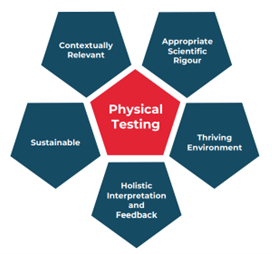
These factors are not only a source of frustration for those conducting the testing, but can also negatively influence the athlete experience. To tackle this, a multidisciplinary team of practitioners created a set of Physical Testing Guidelines based upon collective experience and knowledge. By using the five components of the model to guide decision making, we believe that physical testing can play a key role in the long-term development of individuals and sporting systems.
The Challenge
In September 2023, Sport Wales were approached by Welsh Athletics to support two Cardiff based testing days catering for over 100 athletes across the pathway and performance squads. The aims of the project were to collect data across various biopsychosocial qualities to support athlete development and the evolution of the performance programme. Through constructive discussions, Sport Wales challenged the idea that physical testing should be used to inform Talent ID and selection due to unintended biases associated with this approach, such as favouring early maturing athletes or prioritising physical qualities over other critical characteristics. Therefore, the agreed outcomes were to use testing to gain an understanding of individual athlete profiles, establish a starting point for systematic monitoring, and use insight to inform system-based problem solving and coach development. Furthermore, this provided an opportunity for Sport Wales to implement and review the decision making guidelines in collaboration with Welsh Athletics.
The Impact
Following a collaborative planning process, we identified a number of opportunities to positively influence the outcomes of the project:
• Test selection was refined to be more age and stage appropriate The original testing battery was debated by Welsh Athletics and Sport Wales, and refined to one that was both contextually relevant for the age and stage of athletes and logistically feasible for the number of participants. This included a reduction in the overall number of tests and the removal of those that were considered too advanced for the majority of pathway athletes, such as maximal isometric testing. By reducing the number of tests and focusing on effective sequencing we were confident that data could be collected reliably and efficiently. Lastly, it was agreed that the number of coaches and practitioners helping on the day would be essential in ensuring the event ran smoothly. Cardiff Met provided physiology interns to support Welsh Athletics and Sport Wales staff, who not only proved vital at each testing station but also gained experience in supporting large scale testing. An overview of the final testing process from an athlete’s perspective can be seen here.
• Athlete experience was placed at the forefront of delivery Welsh Athletics and Sport Wales focused on creating a positive learning environment for athletes, as well as considering how we wanted coaches and parents to experience the day. The importance of good briefing and debriefing processes was emphasised, in addition to ensuring the environment was set up for athletes and coaches to ask questions throughout the testing process. Efforts were made to make the testing as inclusive as possible for athletes with impairments, and athletes were given the choice over male or female practitioners for the physiotherapy and capacity screening. Finally, thought was given to how the experience could be captured and reviewed, with a questionnaire being sent to athletes, coaches and parents following the testing days.
• Data was interpreted and fed back through a developmental lens Considerations were given to how athletes would receive their data through Teamworks Athlete Management System, with a priority placed on feeding back through a developmental lens e.g. focusing on strengths and reframing weaknesses as opportunities that can support an athlete’s long term sporting ambitions. Welsh Athletics fed back information to athletes and coaches in person, with an emphasis on a holistic understanding of the data. For example, physical data was presented as only one form of information, with a behavioural profile also being used to support future development.
• The sustainability of testing was considered from the outset
Welsh Athletics staff were upskilled in using Teamworks and Vald equipment, and provided ongoing support following the project to transition towards managing testing processes independently. Teamworks offered a platform for data to be easily uploaded, shared and interpreted for any future testing events, providing a data management solution to support long term athlete development and understanding. Since the initial testing, Welsh Athletics have conducted a number of smaller testing events as part of the National Development Programme and continue to use this data to evolve the performance pathway.
This process demonstrated how Sport Wales can imbed within the planning and delivery phases of projects to provide specific expertise, and work collaboratively alongside NGB’s and universities to achieve successful outcomes.
What did we learn?
Athlete, coach and parent feedback
21 athletes, 4 coaches and 2 parents provided feedback following the testing days, citing an average positive experience of 9/10. Whilst this may only represent a small percentage of the overall attendees, positive feedback included the following:
- ‘‘Understanding of why we are testing and what the tests themselves are looking at (something I am always interested in learning about). It was great to speak to Welsh Athletics staff and see fellow athletes. I’m looking forward to receiving the results and finding out ways to improve etc.’’ (Athlete)
- ‘‘Potentially start to include more plyometric work in training as I think it’s not utilised enough at present’’ (Coach)
- ‘‘The whole package including professionalism and technology.’’ (Parent)
Recommendations for future testing events included more event specific testing, smaller groups, faster processes, things to do in between testing stations, results available on the day, and less travel time.
Welsh Athletics and Sport Wales reflections
Both Welsh Athletics and Sport Wales debriefed internally and met to share feedback, with positives including:
- Witnessing athletes enjoy the experience, evident through ‘smiles on faces’
- Role modelling through mixing of event groups and ages
- Athletes with impairments adopting a ‘give it a go’ attitude towards each test
- Self-led warm ups providing an excellent observational opportunity for coaches and staff
- Large amounts of data collected efficiently
Areas to consider for future testing included:
- Providing more time for athlete and staff familiarisation
- Addressing the quality of calf and hamstring capacity testing
- Integrating specific female athlete considerations into testing
- Capturing athlete experiences in real time
- Further engaging coaches and parents
The Physical Testing Decision Making Guidelines were reviewed and updated following the project, to ensure better usability in the future. We hope that by continuing to use the guidelines with partners in this way, physical testing can be used positively to support athlete development, identify coach development opportunities and support knowledge sharing across the Welsh system.